DDEV v1.25.6: PHP 8.6.0 and PHP Security Fixes

DDEV v1.25.6 comes less than a month after v1.25.5, because PHP released security fixes and PHP 8.6.0 on November 19, and we wanted ddev-webserver to ship them. It also brings over 100 PRs from the DDEV community: your suggestions, bug reports, code, and financial support made them possible.
Table of Contents
- PHP Security Fixes
- PHP 8.6.0
- A Form for
ddev config - New Tables in
ddev listandddev describe - Cache Volumes for Each Project
- Security Changes
- Regressions, Fixed
- Everything Else
PHP Security Fixes
ddev-webserver now ships PHP 8.5.13, 8.4.28, 8.3.37, and 8.2.36, which fix 17 advisories. Projects on PHP 5.6 through 8.1 get the same fixes from deb.sury.org, with unchanged version numbers. Each project picks them up the next time it starts.
None of the advisories looks urgent for a default DDEV project. DDEV’s session.upload_progress.enabled = 0 and zend.exception_ignore_args = On block two of the critical ones, and the way DDEV runs PHP-FPM makes the FPM ones unreachable or harmless. A custom configuration, such as a file-based error_log or fastcgi_keep_conn on, can open some of them again. Nine others depend on your project’s own code, such as session handling or SOAP endpoints, and only the PHP update fixes them.
New PHP patch releases, such as security fixes, reach deb.sury.org before the next DDEV release. This file upgrades the PHP packages in your project’s web image when you rebuild it:
# .ddev/web-build/Dockerfile.php-upgrade
# Safe to keep; you can delete it after upgrading DDEV
RUN (apt-get update || true) && apt-get install -y --only-upgrade 'php*'
ddev restart --no-cache
ddev php -vSee php_version.
PHP 8.6.0
DDEV now ships the PHP 8.6.0 release. To try it:
ddev config --php-version=8.6 && ddev restartThe apcu, imagick, memcached, redis, uploadprogress, xdebug, xhprof, xmlrpc, and yaml extensions aren’t built for PHP 8.6 yet, so you can’t use them there.
A Form for ddev config
Interactive ddev config shows what DDEV detected in a form, where you can also change the PHP version, database, and web server. Enter saves it as it is:
Choosing a project type brings its recommended PHP version, database, and web server, and choosing a database type brings its default version. Esc exits without writing anything.
A script that pipes answers into bare ddev config now needs a leading no line, because the first question asks whether to use the suggested configuration. Flags, as in ddev config --project-type=drupal11 --docroot=web, don’t depend on the questions.
New Tables in ddev list and ddev describe
ddev list, ddev describe, and ddev snapshot --list now fit the terminal width and look like ddev tui. Here are eight demo projects in v1.25.5 (top) and v1.25.6 (bottom):
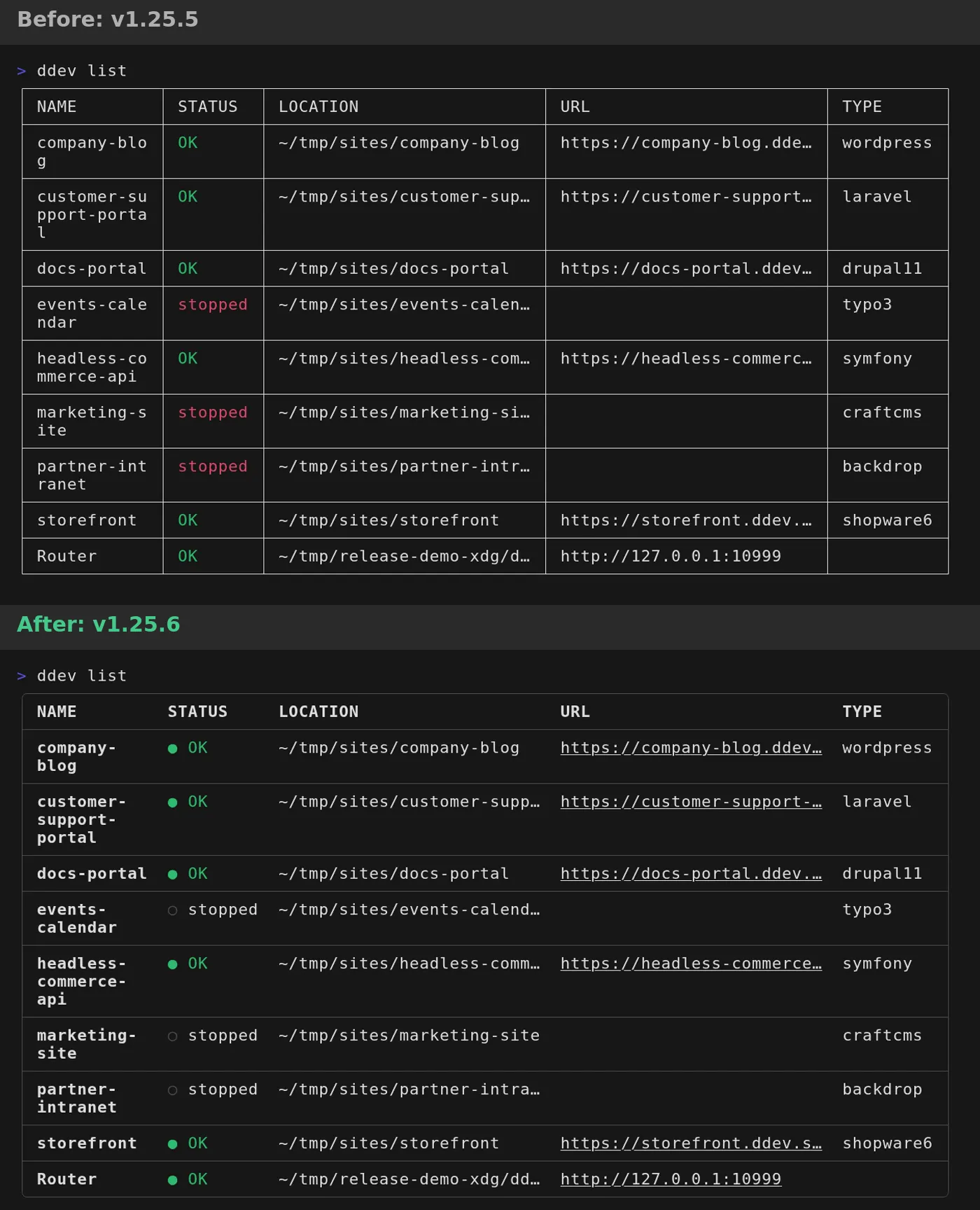
Project names wrap at hyphens instead of in the middle of a word, each status has a symbol, and long URLs are shortened without breaking the link. If a script reads these tables, switch it to -j for JSON.
Cache Volumes for Each Project
This is the change you are most likely to notice. Until now, all projects shared their Composer, npm, and Yarn caches and shell history in the ddev-global-cache volume, so the Terminus cache, for example, carried one project’s Pantheon login into other projects. Each project now has its own cache volumes, so after upgrading:
- Bash and MySQL history start empty.
- The first Composer or npm install in each project downloads everything again.
- Add-ons that write to
/mnt/ddev-global-cachefromweblose that data on restart until they mount the volume themselves, as Theddev-global-cacheVolume shows.
The old caches stay in ddev-global-cache. To free that space, remove the volume, and DDEV creates it again on the next start:
ddev poweroff
docker volume rm ddev-global-cache
Security Changes
- A crafted archive in
ddev add-on get,ddev import-db, orddev import-filescould write outside its destination through relative symlinks. This is fixed, see GHSA-vxj4-5gfg-97c2. - PHP files in directories that DDEV’s nginx configuration denies, such as TYPO3
vendor, CodeIgnitersystem, and hidden directories, no longer run, thanks to @Atesca. - nginx now denies what the CMS’s
.htaccessdenies on Apache, such as Drupal’s*.ymland*.twigfiles, Magento 1’sapp/etc/local.xmlwith the database credentials, and Maho’s customer uploads. Apache denies dotfiles such as.envand.git/. If you removed#ddev-generatedfrom.ddev/nginx_full/nginx-site.confor.ddev/apache/apache-site.conf, merge the changes from the new template. - The
ddev-xhguiimage had PHP and nginx from July 2025, and now gets current Alpine packages.
Regressions, Fixed
- Usage data is sent again if you opted in. v1.25.5 sent nothing.
- Lines you type after a command that reads the terminal, like the Craft CMS setup wizard, are no longer dropped. This broke in v1.25.3.
Everything Else
When you run DDEV in GitHub Actions, GitLab CI, or another CI system, ddev start passes its CI variable into the web container, so tools there skip prompts and progress bars. The Wagtail quickstart builds its virtual environment in the web image. A restarted web or xhgui container no longer takes about 60 seconds to become healthy, and custom command files keep their group-write bit and ACLs, thanks to @steffenmaechtel. See the release notes for the rest.
From all of us, thanks for using, promoting, contributing, and supporting DDEV!
If you have questions, reach out in any of the support channels.
If you wonder how all this could be done, it’s because of generous sponsors who let two of us work on this every day. If you and your team aren’t already financially supporting DDEV, consider joining our sponsors.
Follow our blog, Bluesky, LinkedIn, Mastodon, and join us on Discord. Sign up for the monthly newsletter.
This article was edited and refined with assistance from Claude Code.